How to read a postal paycheck
A practical guide to understanding USPS pay stubs, line by line, with examples and tips to verify accuracy.
How to read a postal paycheck
If you work for the United States Postal Service (USPS) or want to understand a USPS paycheck, you’re not alone in feeling a little overwhelmed the first time you look at a pay stub. USPS pay stubs can include several line items, codes, and abbreviations tied to specific pay rules, timekeeping systems, and leave accrual. This guide lays out a practical, step-by-step approach to reading a postal paycheck so you can verify accuracy and understand how your pay was calculated in the current period and over the year to date.
Table comparing pay stub sections and what they show
| Section | What it shows (summary) | Key data points | How to read | Common abbreviations | Example note |
|---|---|---|---|---|---|
| How a USPS pay stub is structured | Overall layout of stub | Employer, employee, period | Scan top to bottom | STD, NET, YTD | Use as roadmap |
| Reading the earnings section | Timekeeping and pay codes | Hours, code, rate, gross | Match codes to work | OT, REG, DMV | Check for discrepancies |
| Deductions: taxes, benefits, retirement | Deductions list and totals | Tax, benefit, retirement amounts | Compare to gross | FICA, SIT, 401(k) | Verify contributions |
| A practical approach: quick read | Validation steps | Visual checks, totals | Quick skim steps | N/A | Use checklist |
| A sample pay stub breakdown | Illustrative example | Sample figures | Walkthrough | N/A | Helpful anchor |
Compiled November 2026; check the provider's site for current details.
How a USPS pay stub is structured
A typical USPS pay stub falls into two broad categories: earnings for the current pay period and deductions that come out of gross pay. There’s also a timekeeping/tracking component that ties your hours worked to the amount earned, along with leave and leave accrual details.
Key elements you’ll commonly encounter:
- Earnings: Regular wages, overtime, premiums, and any special pay.
- Leave and holidays: Sick leave, annual leave, holiday pay, and any paid time off.
- Deductions: Federal income tax, Social Security (OASDI), Medicare, health insurance, or retirement contributions.
- Net pay: The amount you receive after all deductions.
Understanding where each piece fits helps you audit your pay and catch mistakes early.
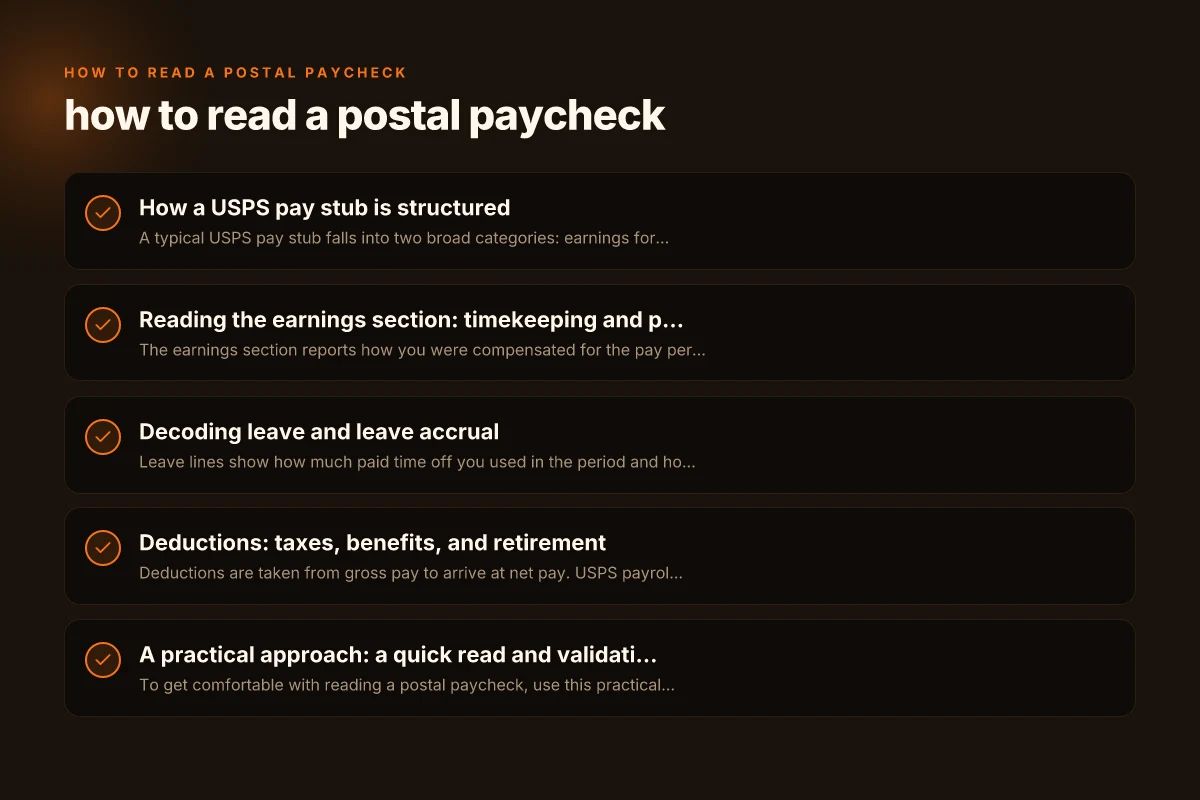
Reading the earnings section: timekeeping and pay codes
The earnings section reports how you were compensated for the pay period. USPS uses a timekeeping system and pay codes that map to how many hours you worked, what kind of work you did, and whether you earned premiums for holidays or overtime. How to use the eufy app on firestick for home security monitoring
What to look for:
- Regular earnings: The standard hourly rate or grade-based rate times hours worked.
- Overtime or premium pay: Look for lines labeled OT, O/T, or premium pay for holidays, Sundays, or night shifts.
- Special pay: Any additional pay items, such as hazardous duty, instructor pay, or training allowances.
- Time worked: May appear as hours or days, sometimes broken down into days of regular work, regular time on a given date, and any premium time.
Tip: In some USPS pay stubs, the line items may be grouped or abbreviated. If you’re unsure about a code, refer to the USPS timekeeping or payroll guidance your department provides (or the help PDF often included with pay stubs).
Decoding leave and leave accrual
Leave lines show how much paid time off you used in the period and how much leave you have available. They also reflect how leave is counted for the period and in the cumulative totals.
Key points: Energizer vs energizer industrial: what’s the difference and which should you choose
- Sick leave vs. annual leave: Sick leave is typically a separate line item from annual leave. Each may show hours or days.
- Leave taken during the pay period: This reduces gross pay if you’re in a paid leave status, or it impacts the calculation of combined time worked and leave when tracking accruals.
- Leave accrual balance: Some stubs include an ending balance for leave on hand, which is useful for planning future time off.
How to spot possible issues:
- If you see sick leave significantly different from what you expected, check your timesheet for accuracy.
- If leave was requested but not reflected, confirm whether it posted to the correct pay period.
Deductions: taxes, benefits, and retirement
Deductions are taken from gross pay to arrive at net pay. USPS payroll can include standard federal and state (where applicable) taxes, Social Security, Medicare, health benefits, retirement contributions, union dues, and other deductions.
What to review:
- Taxes: Federal and state income taxes are shown as separate lines. Verify tax withholding amounts correspond to your W-4 selections.
- Social Security and Medicare: These are standard FICA contributions and usually appear as separate line items.
- Benefits: Health, life, dental, and other benefits may be itemized.
- Retirement and unions: USPS has specific retirement plans and, in some cases, union dues or assessments may show up as deductions.
Tips: Does tp link deco work with virgin media the definitive guide
- Compare deductions against your benefits enrollment and your latest benefits election. If you recently changed plans, ensure the changes are reflected in the correct pay period.
- If a deduction seems unusually high or missing, check recent correspondence about changes to benefits or payroll with your HR or benefits administrator.
Table of common pay codes and what they mean
| Code | Description | Typical amount type | When it changes | Example scenarios | Validation tip |
|---|---|---|---|---|---|
| REG | Regular hours pay | Gross pay | Every pay period | 40h/wk | Verify hours match |
| OT | Overtime | Overtime pay | Overtime hours | 5h OT | Check rate applied |
| REGD | Regular daily | Daily pay | Shift-based | Weekend work | Confirm daily totals |
| VAC | Vacation leave | Leave pay | When using leave | 8h VAC | Ensure accrual vs usage |
| SICK | Sick leave | Leave pay | Sick days | 4h SICK | Validate leave balance |
| FICA | Social Security | Tax deduction | All pay periods | Employee share | Ensure proper rate |
| MED | Medicare | Tax deduction | All pay periods | 1.45% | Confirm taxable wages |
| 401K | Retirement plan | Deduction | Contribution period | 5% of gross | Check employer match if any |
Compiled November 2026; check the provider's site for current details.
A practical approach: a quick read and validation checklist
To get comfortable with reading a postal paycheck, use this practical approach:
- Confirm pay period dates: Make sure you’re looking at the correct period. Pay periods are typically biweekly for many USPS roles, but formats vary.
- Match hours to earnings: Compare hours reported for the period with your timesheet. If there’s a mismatch, investigate possible data entry errors or timekeeping issues.
- Review leave lines: Check that leave used in the period aligns with the amounts you requested and that leaves are correctly deducted from accruals.
- Check totals: Ensure Gross pay minus Deductions equals Net pay. If there’s a discrepancy, re-check each deduction line item.
- Verify year-to-date totals: Year-to-date earnings, deductions, and net pay should progress logically from the start of the year. Large, unexplained jumps merit closer scrutiny.
- Cross-check with ePayroll and timesheets: If your organization uses an ePayroll system or a separate timesheet portal, a mismatch between these sources and the pay stub is a red flag.
A sample pay stub breakdown (illustrative example)
Below is a simplified, generic example to illustrate how the numbers might appear. Note that the actual format and codes on a USPS pay stub can differ by local district and payroll system. Does ring camera work with 5ghz Wi-Fi the definitive guide
- Earnings:
- Regular pay: 80.0 hours @ $25.00 = $2,000.00
- Overtime: 5.0 hours @ $37.50 = $187.50
- Holiday pay: 8.0 hours @ $29.00 = $232.00
- Leave:
- Sick leave used: 3.0 hours = $0.00 (often paid as part of regular time)
- Annual leave used: 4.0 hours = $0.00
- Deductions:
- Federal tax: $210.00
- Social Security: $124.00
- Medicare: $29.00
- Health insurance: $120.00
- Retirement contribution: $150.00
- Net pay: $1,986.50
If you see a similar structure, you can parenthetically confirm:
- Gross pay = sum of all earnings lines
- Total deductions = sum of all deduction lines
- Net pay = Gross pay – Deductions
A simple table can help your eyes skim:
Earnings | Amount
- Regular pay | $2,000.00
- Overtime | $187.50
- Holiday pay | $232.00 Total Gross | $2,419.50
Deductions | Amount Do you pay taxes on washington paid family leave
- Federal tax | $210.00
- Social Security | $124.00
- Medicare | $29.00
- Health insurance | $120.00
- Retirement | $150.00 Total Deductions | $633.00
Net pay | $1,986.50
This table format makes it easier to verify arithmetic at a glance.
Table: Leave and accrual vs usage comparison
| Leave type | Accrual rate | Maximum balance | Used this period | Carryover allowed | Important note |
|---|---|---|---|---|---|
| VAC | hours per pay period | cap hours | 0– | yes | Check accrual posting |
| SICK | hours per pay period | cap hours | 0– | yes | Monitor usage |
| LWOP | non-paid | none | 0– | no | Totals may affect benefits |
| HOL | paid holiday | varies | 0– | yes | Verify holiday entitlement |
| CARRYOVER | – | policy dependent | – | yes | Read policy document |
Compiled November 2026; check the provider's site for current details. Do eufy cameras work with 5ghz WiFi the complete guide
How to resolve common issues
Payroll discrepancies can happen. Here are common scenarios and how to approach them:
- Missing hours or wrong overtime: Review the timesheet entry. Sometimes a supervisor must approve or correct missing entries.
- Incorrect leave deduction: Check your leave request records and accrual ledger. A payroll change may require retroactive adjustments.
- Wrong tax withholding: Ensure your W-4.
What to do:
- Document the discrepancy with dates, hours, and codes.
- Bring this documentation to your HR or payroll contact.
- If you notice a recurring issue in multiple pay periods, request a payroll audit or a formal review.
How the USPS timekeeping and ePayroll relate to pay stubs
Many USPS employees access timekeeping data using an internal system or portal, sometimes referred to as ePayroll or the USPS payroll interface. The pay stub reflects what is recorded in those systems for a given period.
- Timekeeping: The hours and types of pay day-by-day link to the earnings on the stub.
- ePayroll: The source that aggregates hours, leave, and codes into a payroll batch.
- Form numbers and codes: Some stubs reference internal forms or check numbers that help you identify the payroll batch and sequence.
If you have access issues or cannot locate the corresponding timekeeping entry, consult your local HR or the payroll department. They can provide a copy of the timekeeping record corresponding to the pay period. Hr payroll department of education tasmania
Table: Timekeeping and payroll relation to stubs
| Topic | USPS timekeeping system | ePayroll linkage | Stub impact | Common mismatch | How to verify |
|---|---|---|---|---|---|
| Recording hours | Timestamps, codes | Linked to payroll | Yes/No | Hours differ | Reconcile timecard to gross |
| Pay codes | Timekeeping codes | Payroll codes | Yes/No | Incorrect code | Cross-check code list |
| Deductions | Based on gross | Pre/post adjustments | Affects net | Under/over deduction | Compare to benefits enrollment |
| YTD totals | Cumulative | Snapshot sync | Yes/No | Out-of-sync | Year-to-date check |
Compiled November 2026; check the provider's site for current details.
Keeping track over time: year-to-date and planning ahead
Beyond the current period, your pay stub is a window into the year-to-date totals. Tracking YTD earnings and deductions helps you plan:
- Tax planning and withholdings
- Leave accruals and usage
- Health benefits and retirement contributions you’re committing to
If you’re planning significant leave or a career move, pull several consecutive pay stubs to see how YTD numbers accumulate and verify the consistency of the earned amounts. Is philips hue compatible with tuya
Short-term tips:
- Save a digital copy of each pay stub in a dedicated folder for your records.
- Reconcile the quarterly or annual statements with IRS or government-provided compensation summaries if applicable.
The takeaway: reading a postal paycheck with confidence
Reading a USPS pay stub is about spotting the relationships among hours worked, earnings, leave usage, and deductions. By breaking the stub into earnings, leave, and deductions, and then validating each section against your timesheets, leave requests, and benefits elections, you gain a clear view of how your net pay was calculated.
If you’re new to USPS pay stubs, start with a single period, then layer in year-to-date totals as you become more comfortable with the codes and the layout. When in doubt, reach out to your HR or payroll contact with a short list of questions, including the pay period dates, the hours reported, and the specific deduction line items you’re unsure about.
Final recommendation: keep an organized habit of reviewing pay stubs as soon as they arrive, and don’t wait until tax season to discover discrepancies. A proactive approach builds confidence in your compensation, supports accurate records, and helps you plan your finances with greater certainty.