Bosch oe vs a vs b wiper blades
A clear guide to what OE, A, and B mean on Bosch wiper blades and how to choose the right version for your vehicle.
Wiper blades are a small part of your car, but the right variant can save you time, affect visibility, and improve reliability. When you see Bosch wiper blade variants labeled OE, A, or B, it’s natural to wonder what the differences are and which to choose. This guide breaks down what those letters mean, how they affect fit and performance, and how to pick the right Bosch blade for your car.
Quick reference — A, B, and OE at a glance
| Variant | Purpose | Typical compatibility | When to choose | Notable limitations | Common abbreviations |
|---|---|---|---|---|---|
| OE | Original equipment | Car’s factory setup | Replace like-for-like | Availability may vary | OE, OEM |
| A | Intermediate/high performance | Broad compatibility | Upgrading performance | May not fit all OEM rakes | A, A-line |
| B | Budget/general use | General replacement | Cost-conscious fixes | May lag on performance | B, B-line |
Compiled November 2026; check the provider's site for current details.
What OE, A, and B mean on Bosch wiper blades
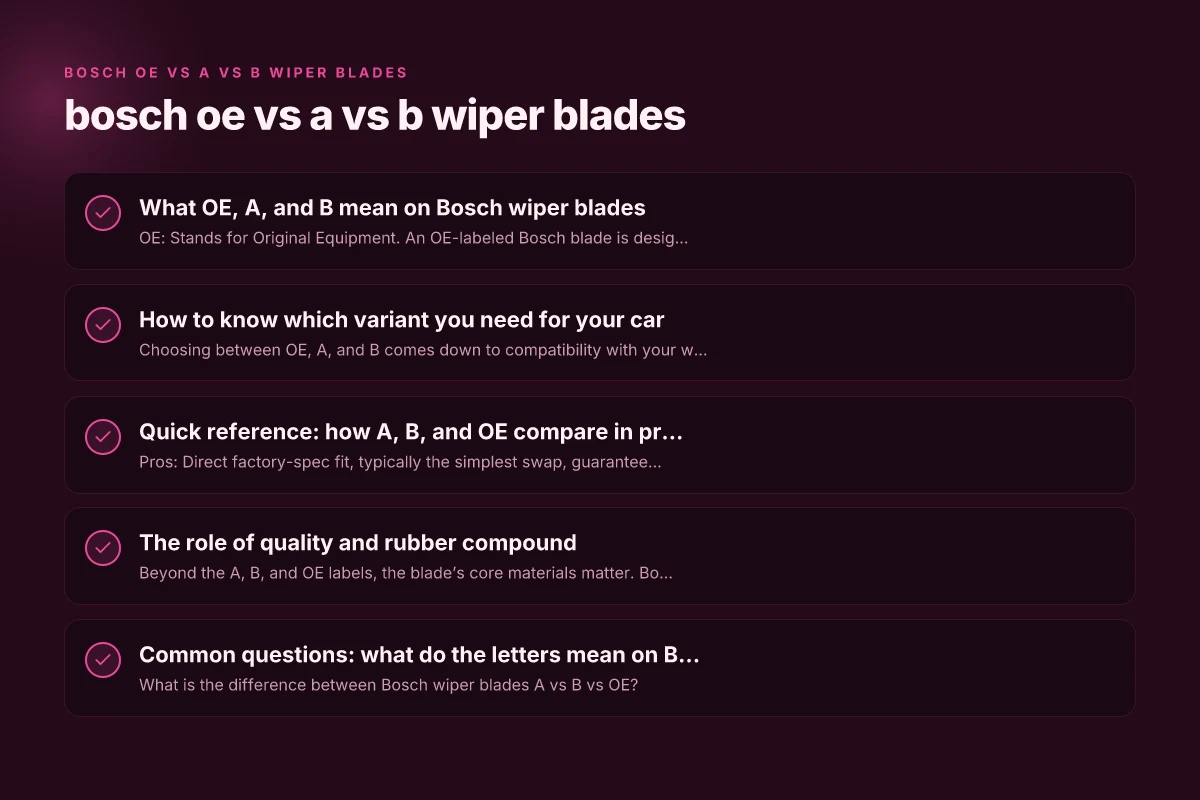
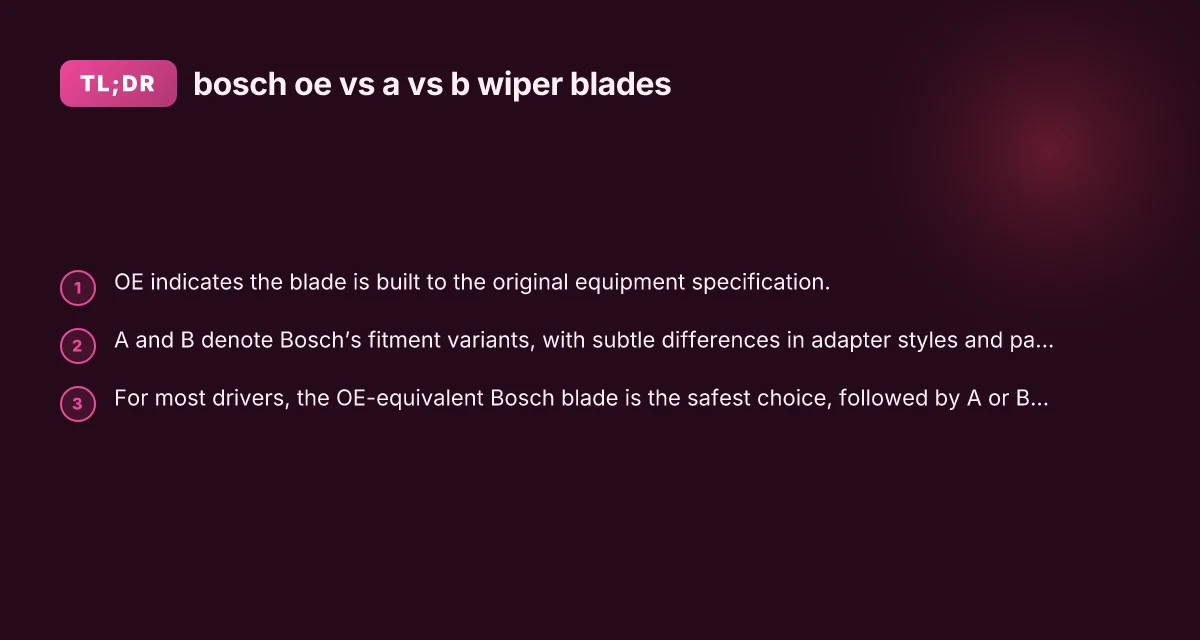
- OE: Stands for Original Equipment. An OE-labeled Bosch blade is designed to meet or mirror the original blade specification that came on your vehicle from the factory. It’s built to match OEM dimensions, attachment points, and performance targets.
- A and B: These are Bosch’s aftermarket fitments that reuse the same overall blade design but may use different adapters, hooks, or end caps. A and B are typically intended to cover alternative mounting styles that appear on a subset of vehicles or model years. They are not “lower quality,” but they can differ in how they clip, snap, or attach to the wiper arm.
Why Bosch uses A and B variants isn’t about performance per se. It’s about compatibility with different arm designs, connection hardware, and sometimes packaging. The goal is to provide a blade that fits without modification across a broad range of vehicles, while still delivering Bosch’s standard performance.
How to know which variant you need for your car
Choosing between OE, A, and B comes down to compatibility with your windshield wiper arm and how the blade attaches. The most reliable approach is to verify fitment for your exact make, model, and year.
- Check your vehicle’s owner manual or the Bosch site for fitment notes.
- Use Bosch’s “wiper finder” tool or consult your parts retailer with your VIN.
- If you’ve previously used Bosch blades and know your mounting style (hook, pin, side-mlip, etc.), you can match the style to A or B accordingly.
If you’re replacing with an OE blade, you typically get a direct match to the original attachment mechanism. If you’re buying A or B, confirm the specific connector type to avoid a mismatch.
Quick reference: how A, B, and OE compare in practice
- OE
- Pros: Direct factory-spec fit, typically the simplest swap, guaranteed compatibility for the original mounting.
- Cons: May be priced higher than aftermarket variants.
- A
- Pros: Often a close fit for many common arm designs. Can be a cost-effective option.
- Cons: Some vehicles may require the exact OE or a B variant. Misfit risk if the mounting style isn’t matched.
- B
- Pros: Similar to A, sometimes used to cover slightly different eyelets or end-caps. Broader compatibility across a wider model range.
- Cons: Potential for confusion if not matched to the vehicle. Ensure you’re choosing the correct connector type.
Below is a simplified comparison table to help visualize the general intent. Note: exact compatibility depends on your vehicle’s year, model, and trim. 360 Feedback examples start stop continue
| Variant | Typical use | Connector/Attachment notes | fitment risk | Price range (general) |
|---|---|---|---|---|
| OE | Factory-equivalent | Direct OEM attachment | Low | Moderate to high |
| A | Broad aftermarket fit | A variant adapter; confirm by vehicle | Medium | Moderate |
| B | Wider compatibility | B variant adapter; confirm by vehicle | Medium | Moderate |
Remember, the table above is a general guide. Bosch’s own fitment tool and retailer guidance should be your primary sources for confirming the right variant.
Decision guide — How to know which variant you need
| Criterion | OE needs | A needs | B needs | How to verify | Practical tip |
|---|---|---|---|---|---|
| Car model match | Yes | Yes if compatible | Yes if compatible | Check vehicle make/model, year | Start with OEM data |
| Wiping performance | Standard OE quality | Improved performance | Basic performance | Consider climate and debris | If in doubt, start with A |
| Longevity expectation | Original lifespan | Moderate lifespans | Shorter lifespan possible | Look at rubber compound notes | For harsh climates, favor A or OE |
| Fitment notes | Exact fit | Broad fit may require adapter | Broad fit | Read product specs | Verify blade length/arm type |
| Price tier | High | Mid | Low | Compare SKUs | Balance cost vs performance |
Compiled November 2026; check the provider's site for current details.
The role of quality and rubber compound
Beyond the A, B, and OE labels, the blade’s core materials matter. Bosch describes its ICON line and other premium blades as using durable rubber compounds, ozone resistance, and optimized blade profiles. The actual performance you feel in rain or sleet comes from: Why your xfinity hotspot isn't working
- Rubber compound stability over temperature cycles
- Wiper blade arc and pressure distribution across the windshield
- The attachment method’s reliability and ease of replacement
Even with the same attachment style, a blade with a good rubber compound and a well-designed squeegee will perform better and last longer than a cheaper alternative.
Common questions: what do the letters mean on Bosch wiper blades?
- What is the difference between Bosch wiper blades A vs B vs OE?
- A and B are aftermarket fitments designed to cover alternate mounting styles. OE is the factory equivalent. The practical difference is whether your vehicle’s mounting style matches the blade’s adapter.
- Are OE blades always the best choice?
- For most drivers, OE blades provide the simplest, most reliable fit. If you’re price-sensitive or your vehicle uses a common aftermarket adapter, an A or B blade can be a good alternative, so long as you confirm the exact connector type.
- Can I mix and match blades (driver side vs passenger side) with A or B?
- It’s possible but not ideal. If your car uses different attachments across the two wiper arms, you’ll want to choose the correct variant for each side or ensure both blades are compatible with the mounting styles present.
Practical tips for buying Bosch blades
- Always confirm fitment with your specific vehicle (make, model, year) and, if possible, your VIN.
- If you’re unsure about the mounting style, bring your current blade or take a photo of the attachment to the retailer.
- When in doubt, opt for OE for a stress-free swap. If budget is a concern, A or B can be solid alternatives as long as you’ve verified the connector compatibility.
- Consider climate and driving conditions. If you frequently drive in hot sun, ozone exposure, or icy conditions, choose a blade with a robust rubber compound and proven performance under those conditions.
- Read customer reviews for your exact vehicle and blade variant. Some vehicle families have quirks that aren’t obvious from the labeling alone.
Practical buying tips — practical considerations and quick checks
| Tip category | What to check | How to check | Recommended action | Notes |
|---|---|---|---|---|
| Vehicle spec | Correct blade length | Measure or confirm from manual | Use OEM length | A/B/OE variants share lengths |
| Climate | Rain/snow exposure | Local weather history | Prefer A or OE in extreme weather | Rubber compound matters |
| Rubber quality | Damping, flexibility | Press blade, inspect edge | Choose higher grade (OE/A) | Better longevity in fast temps |
| Compatibility | Arm type | Visual compare with existing blade | Pick exact fit or compatible | Some A/B versions are universal |
| Price | Per blade cost | Check per-axle vs pair | Prefer value pack if available | Consider replacement frequency |
Compiled November 2026; check the provider's site for current details.
Real-world considerations: a quick scenario
- You drive a modern sedan from a common brand. Your owner’s manual indicates a standard blade length and a standard hook-style mount. You discover that Bosch offers OE blades in your blade length package and batch, but A and B variants exist for similar lengths. In this case:
- Start with the OE variant to guarantee fit and performance.
- If the price is much higher or stock is tight, check whether A or B matches your mounting hardware and pricing. Many drivers find A or B works well for their model year, but confirmation is essential.
- You own a vehicle with a slightly unusual mounting system or a rare trim. In this case, OE remains the safest bet, or you may need to consult the Bosch fitment tool and the retailer to identify the closest compatible A or B option.
Final recommendation
For most drivers, the safest, simplest choice is to go with the OE variant when you’re replacing Bosch wiper blades. OE blades are designed to mirror the factory specification, ensuring a clean install and reliable performance without second-guessing the mounting hardware. If OE is not available or if you’re looking to save money, an A or B variant can be a solid alternative, provided you confirm the exact connector type used on your vehicle and match it to the blade you select. Washington paid family leave stacking with fmla
If you want a quick rule of thumb: OE first, then A or B only after you’ve verified the mounting compatibility. When in doubt, consult Bosch’s fitment tools or ask a trusted retailer to confirm the right variant for your specific vehicle. With the right blade, you’ll experience clear visibility in rain, snow, and sun with minimal hassle.