360 Feedback examples start stop continue

A practical guide to using 360 feedback with start, stop, continue examples and templates to drive improvement.
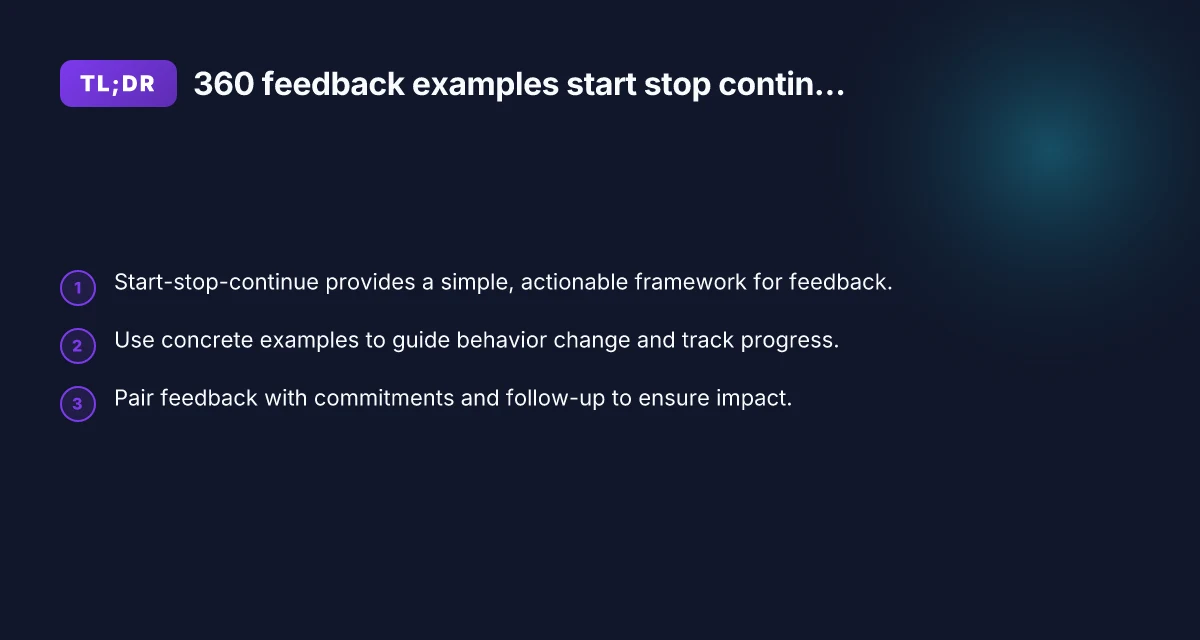
Feedback is most effective when it’s concrete, actionable, and tied to observable behavior. The start stop continue (SSC) framework is one of the simplest ways to structure 360 feedback so individuals can see what to begin doing, stop doing, and keep doing. Below you’ll find practical SSC examples you can adapt for individuals, teams, and leadership contexts, plus a quick template to organize a 360 feedback session.
Comparison of SSC usage by context
| Context | Best for individuals | Best for teams | Best for leadership | Complexity | Recommended when |
|---|---|---|---|---|---|
| Start/Stop/Continue | Yes | Yes | Yes | Low | Quick personal growth |
| SSC formats (templates) | Yes | Yes | Yes | Medium | Structured feedback needs |
| Real-world context examples | Yes | Yes | Yes | Medium | Concrete examples help understanding |
| Action translation | Yes | Yes | Yes | Medium | Turn feedback into steps |
| Session facilitation | Yes | Yes | Yes | Medium | Effective SSC session design |
Compiled November 2026; check the provider's site for current details.
What is the start stop continue method?
- Start: Actions or behaviors the person should begin to improve performance or collaboration.
- Stop: Behaviors that hinder progress and should be discontinued.
- Continue: Positive actions that are valuable and should be sustained.
SSC is commonly used in 360 feedback because it’s direct, non-confrontational, and easy to translate into concrete next steps. In a 360 process, input comes from peers, managers, direct reports, and self-evaluation, then distilled into concise SSC statements.
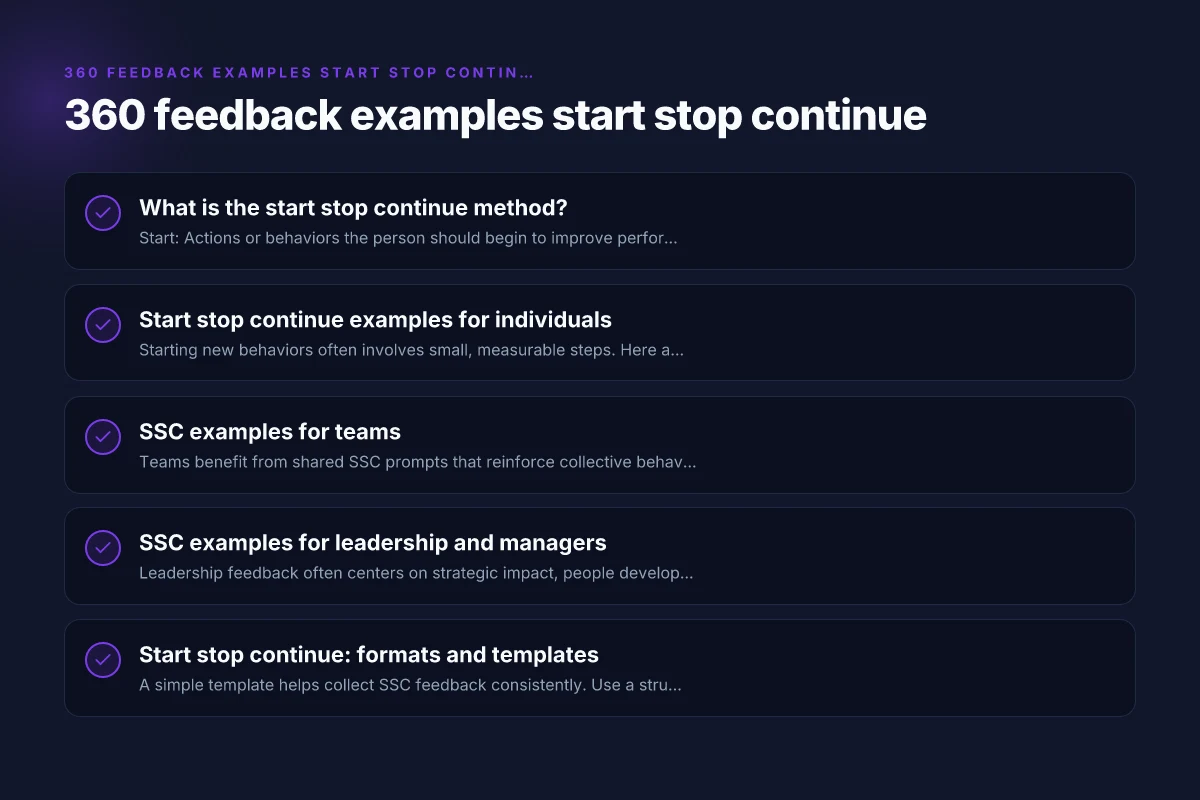
Start stop continue examples for individuals
Starting new behaviors often involves small, measurable steps. Here are ready-to-use examples you can tailor to roles and contexts.
Start
Start documenting decisions in a shared log to improve transparency. Why your xfinity hotspot isn't working
Start scheduling weekly check-ins with teammates to align on priorities.
Start asking clarifying questions when scope is unclear to reduce rework.
Start prioritizing tasks using a clear criteria (impact vs. effort).
Start sharing progress updates in a concise format (e.g., status emails or dashboards). Washington paid family leave stacking with fmla
Stop
Stop interrupting others in meetings and allow space for input.
Stop multitasking during key discussions to protect focus.
Stop over-committing to deadlines without realistic buffers. Wages in Australia vs UK
Stop making assumptions about teammates’ priorities.
Stop siloed decision-making. Seek cross-team input when needed.
Continue
Continue delivering high-quality work on time. Sole proprietorship tax rate in ethiopia
Continue providing constructive feedback to peers.
Continue building strong working relationships with stakeholders.
Continue documenting learnings from projects to improve future work.
Continue staying open to feedback and adjusting behavior accordingly. Self evaluation examples 70 sample answers to inspire you
Comparison of formats and templates
| Format | Length | Anonymity | Quantitative scoring | Qualitative notes | Ease of use | Best for |
|---|---|---|---|---|---|---|
| One-page SSC | Short | Optional | No | Brief | Easy | Quick reviews |
| Detailed template | Medium | Optional | Yes/no | Rich | Moderate | In-depth cycles |
| Hybrid template | Medium | Optional | Yes | Balanced | Moderate | Teams and leaders |
| Simple checklist | Short | Optional | Yes/No | Minimal | Easy | Rapid feedback |
| Action-ready template | Short | Optional | No | Action steps | Easy | Post-session follow-up |
Compiled November 2026; check the provider's site for current details.
SSC examples for teams
Teams benefit from shared SSC prompts that reinforce collective behavior. Use these in team retros or development plans.
Start using a rotating facilitator to run stand-up meetings.
Start keeping a centralized backlog with clear ownership.
Start recognizing small wins publicly to boost morale.
Stop email-only updates for urgent initiatives. Use quick syncs or chat threads.
Stop vague requirements. Ensure acceptance criteria are explicit.
Stop last-minute scope changes that derail timelines.
Continue Club demonstration services payroll app: what it is, how it works, and on-time tips
Continue collaborating across functions to solve cross-cutting problems.
Continue documenting decision rationale in project notes.
Continue maintaining an open feedback culture where challenges are discussed early.
SSC examples for leadership and managers
Leadership feedback often centers on strategic impact, people development, and communication. Here are examples tailored to managers and leaders. Dbs payroll processing time
Start
Start setting clear expectations and measurable goals for the team.
Start providing regular, constructive coaching conversations.
Start sharing the rationale behind major decisions with the team. Do eufy cameras work with 5ghz WiFi the complete guide
Stop
Stop overloading direct reports with excessive meetings.
Stop delaying tough conversations about performance when needed.
Stop introducing new initiatives without validating resource capacity. Do you pay taxes on washington paid family leave
Continue
Continue modeling ethical decision-making and integrity.
Continue investing in team development and succession planning.
Continue recognizing and rewarding high-impact contributions. Does ring camera work with 5ghz Wi-Fi the definitive guide
Start stop continue: formats and templates
A simple template helps collect SSC feedback consistently. Use a structured form during the 360 process, then compile the results into a clean report for the recipient.
SSC template (example)
Start:
[Behavior/Action] - [Why it matters] - [How to measure]
Stop:
[Behavior/Action] - [Impact] - [Alternative approach]
Continue:
[Behavior/Action] - [Impact] - [Evidence or example]
Quick prompts to elicit SSC responses
For Start: What is one new behavior that would help you reach your goals this quarter?
For Stop: Which habit is most blocking your progress right now?
For Continue: Which action consistently leads to positive outcomes?
A simple SSC vs. other 360 formats: when to use which
In practice, SSC is often paired with more comprehensive feedback styles. Here’s a quick comparison to help you choose.
- SSC
- Strength: Quick to understand, easy to action, good for development plans.
- Limitation: May miss nuanced feedback about root causes or broader patterns.
- Narrative feedback
- Strength: Rich context, specific stories illustrate impact.
- Limitation: Can be time-consuming to synthesize into actions.
- Rating scales
- Strength: Clear benchmarks, easy to aggregate.
- Limitation: Can encourage generic feedback and comparison bias.
- 360 with SSC + narrative
- Best of both worlds: actionable next steps plus context and examples.
Table: SSC vs Narrative vs Rating (high level comparison)
| Format | Pros | Cons | Best Use Case |
|---|---|---|---|
| Start/Stop/Continue | Simple, actionable, easy to share | May lack depth or root-cause insights | Individual development plans, quick coaching |
| Narrative feedback | Rich context, memorable examples | Hard to extract concrete actions quickly | Performance improvement through story-based learning |
| Rating scales | Quantifiable, easy to track | Can feel impersonal, prone to bias | Broad performance dashboards, comparisons |
How to run a 360 SSC session effectively
A successful SSC 360 session follows a clear process that respects participants and drives real change.
- Step 1: Define objectives
- Decide whether the SSC output is for development planning, performance review, or team growth.
- Step 2: Gather feedback from diverse sources
- Include peers, direct reports, managers, and self-assessment when possible.
- Step 3: Synthesize into SSC statements
- Transform raw feedback into Start, Stop, Continue statements with concrete examples.
- Step 4: Share feedback with the recipient
- Present in a constructive, private setting. Pair feedback with suggested actions and timelines.
- Step 5: Create an action plan
- The recipient drafts 2–3 commitments for each SSC category, with 30–90 day milestones.
- Step 6: Follow up and review
- Schedule check-ins to review progress and adjust as needed.
Tips to maximize effectiveness
- Use specific behaviors, not personality judgments.
- Tie SSC items to business goals and role responsibilities.
- Encourage both positive and constructive feedback from diverse sources.
- Document commitments with dates, owners, and success criteria.
Real-world 360 SSC examples by context
New managers
Start: Schedule 1-on-1s weekly, share short team updates, and solicit feedback on management style.
Stop: Overreacting to every setback, which signals a lack of psychological safety.
Continue: Providing timely feedback and recognizing team contributions.
High-performing individual contributors
Start: Aligning priorities with broader business goals and communicating progress.
Stop: Over-committing to multiple projects without clarity on scope.
Continue: Producing high-quality work and collaborating effectively with teammates.
Cross-functional teams
Start: Documenting joint decision criteria for shared initiatives.
Stop: Duplicate work caused by inconsistent processes across teams.
Continue: Maintaining open channels for cross-functional communication.
Decision guide by audience and goal
| Audience | Goal | Use case | Recommended format | Signals it’s a fit | Signals it isn’t |
|---|---|---|---|---|---|
| Individual contributor | Personal development | Quick feedback loop | Start/Stop/Continue (simple) | Time constraint, clarity desired | Deep diagnostics needed |
| Team lead | Team improvement | SSC for team dynamics | SSC formats for teams | Collaboration focus | Individual coaching only |
| Manager/Executive | Leadership development | SSC for leadership | SSC examples for leadership and managers | Broad impact, strategic change | Micro-management focus |
| HR/Workspace facilitator | Process consistency | Standardized sessions | Formats and templates | Need for repeatability | Ad-hoc methods only |
Compiled November 2026; check the provider's site for current details.
How to translate SSC feedback into action
- Create a 90-day plan
- Choose 2–3 Start items to pilot, 1 Stop item to reduce impact, and 2 Continue items to reinforce strengths.
- Define measurable indicators
- Examples: number of completed cross-functional meetings, reduction in rework, lead-time improvement.
- Schedule check-ins
- Regularly review progress with a manager or coach to maintain accountability.
- Adjust as needed
- If a Start item isn’t producing results, refine the behavior or replace it with a more feasible alternative.
Common challenges and how to overcome them
- Challenge: Feedback feels vague or personal.
- Solution: Use specific, observable actions and tie to outcomes.
- Challenge: Recipients resist Stop items.
- Solution: Explain the impact on team goals and provide supportive alternatives.
- Challenge: SSC items aren’t tracked.
- Solution: Put each item into an action plan with owners and due dates.
Final recommendations
If you’re implementing 360 feedback with start stop continue, keep it practical. Start with a focused set of SSC statements (3–5 per person), ensure every item is tied to a measurable behavior or outcome, and pair the feedback with a concrete action plan and follow-up cadence. Use SSC as a lightweight engine for continuous development rather than a one-off exercise. When done well, SSC helps individuals and teams shift toward higher performance with clarity, accountability, and constructive momentum.