What Is a Proxy vs VPN? Key Differences and Which to Choose
Learn how proxies and VPNs differ in privacy, encryption, speed, and use cases so you can choose the right tool.
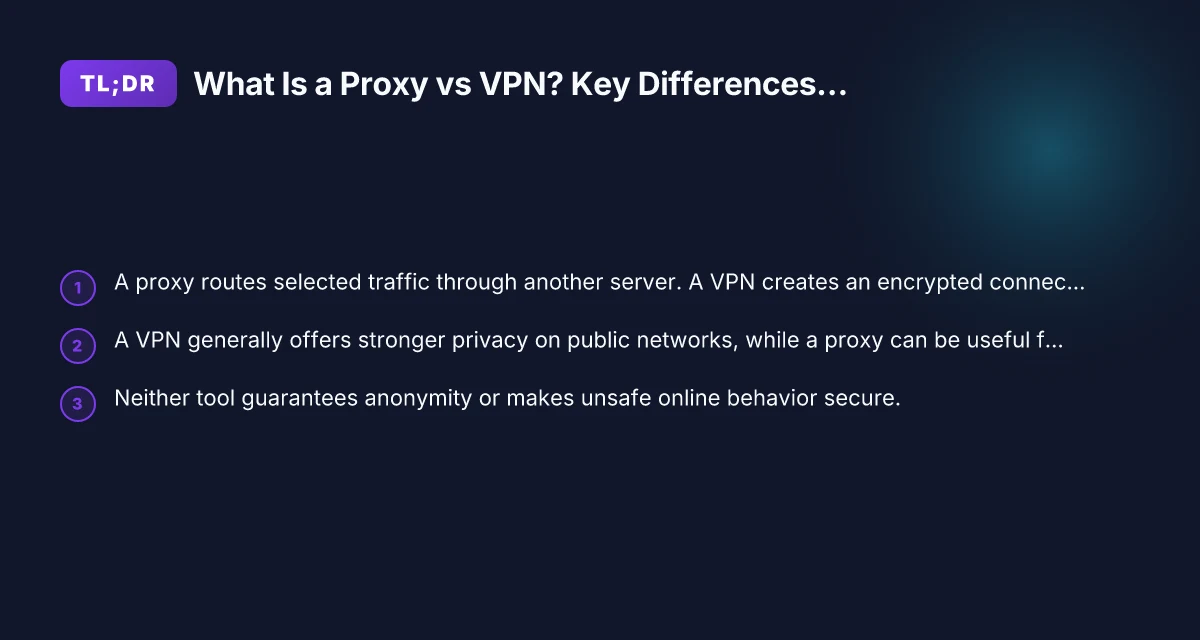
A proxy routes traffic through an intermediary server, while a VPN (virtual private network) sends traffic through an encrypted connection to a VPN server. In practical terms, a proxy is often configured for a particular app or browser, whereas a VPN can protect traffic from multiple apps across a device. Which one is right depends on what you need: changing the apparent location of selected traffic, or adding broader protection and privacy to your connection.
Editor's pick: NordVPN — fast, secure VPN — Strong encryption, a no-logs policy and apps for every device. 30-day money-back guarantee. Get NordVPN →
How proxies and VPNs differ
| Feature | Proxy | VPN |
|---|---|---|
| What it routes | Selected app or browser traffic | Device traffic or selected apps |
| Masks your IP | Yes, for routed traffic | Yes, for traffic through the VPN |
| Encrypts traffic | Usually no | Yes, between device and VPN server |
| Setup scope | Often app-specific | Often device-wide |
| Traffic visibility | Provider may see routed traffic | VPN provider may see traffic metadata |
| Best for | Simple IP changes or app-specific routing | Broader privacy on networks |
| Protection on public Wi-Fi | Limited without encryption | Encrypts traffic to the VPN server |
| Typical trade-off | Less protection | Provider trust and possible speed impact |
Compiled November 2026; check the provider's site for current details.
| VPN | Obfuscation | From / month | Plan | Free plan | Refund | Alipay | UnionPay | Crypto | Website opens in China | Trustpilot | |
|---|---|---|---|---|---|---|---|---|---|---|---|
 ZoogVPN | Turn on manually Shadow | $2.49/mo | 27 months: $59.99 | Yes | 7 days | ✓ | ✓ | ✓ | ✓ | Official site blocked; our special link opens (4.4 s) | 4.2/5 (195 reviews) |
 NordVPN | Turn on manually Obfuscated Servers / NordWhisper | $3.49/mo | 27 months: $94.23 | No | 30 days | ? | ✗ | ✓ | ✓ | ✗ Blocked | 4.2/5 (51,628 reviews) |
 ExpressVPN | ✓ On by default all servers | $3.00/mo | 28 months: $84 | No | 30 days | ✗ | ✗ | ✓ | ✗ | ✗ Blocked | 4.4/5 (29,706 reviews) |
 Surfshark | ✓ On by default Camouflage, with OpenVPN | See site | See site | No | 30 days | ✗ | ✗ | ✗ | ✓ | ✗ Blocked | 4.3/5 (31,823 reviews) |
 Proton VPN | Turn on manually Stealth, free plan too | $2.99/mo | 12 months: $35.88 | Yes | 30 days | ✗ | ✗ | ✗ | ✓ | ✗ Blocked | 2.1/5 (1,040 reviews) |
 Astrill VPN | Turn on manually StealthVPN / OpenWeb | $12.50/mo | 24 months: $300 | No | See site | ✗ | ✗ | ✗ | ✓ | ✗ Blocked | 1.3/5 (110 reviews) |
 Private Internet Access | Turn on manually Shadowsocks, OpenVPN only | $2.03/mo | 40 months: $81.2 | No | 30 days | ✗ | ✗ | ✗ | ✗ | ✗ Blocked | 4.2/5 (11,033 reviews) |
 CyberGhost | Turn on manually selected servers | $2.19/mo | 28 months: $61.32 | No | 45 days | ✗ | ✗ | ✗ | ✓ | ✗ Blocked | 4.0/5 (24,178 reviews) |
 PureVPN | Turn on manually switch to OpenVPN | $1.69/mo | 60 months: $101.55 | No | 31 days | ? | ? | ✗ | ✓ | ✗ Blocked | 4.4/5 (17,994 reviews) |
 AdGuard VPN | ✓ On by default TrustTunnel | $2.99/mo | 24 months: $71.76 | Yes | 30 days | ✓ | ✗ | ✓ | ✓ | Official site blocked; our special link opens (3.7 s) | 4.3/5 (290 reviews) |
 Mullvad | Turn on manually QUIC / Shadowsocks / LWO | $5.61/mo | €5/mo | No | 14 days | ✗ | ✗ | ✗ | ✓ | ✗ Blocked | 3.2/5 (192 reviews) |
 Windscribe | Turn on manually Stealth / WStunnel | $5.75/mo | 12 months: $69 | Yes | See site | ✗ | ✗ | ✗ | ✓ | ✗ Blocked | 4.7/5 (13,355 reviews) |
 StrongVPN | Turn on manually Scramble, OpenVPN TCP | See site | See site | No | 30 days | ✓ | ✗ | ✗ | ✗ | ✗ Blocked | 4.4/5 (2,695 reviews) |
 LightXtreme 闪连 | Not listed | $7.08/mo | 12 months: $84.99 | Yes | 30 days | ✓ | ✓ | ✓ | ✓ | ✓ Yes (3.5 s) | No page |
Prices checked 2026-11-10 on each vendor's pricing page (cheapest long plan, USD). Check the vendor's checkout for the final price.
Obfuscation checked 2026-11-14 on each vendor's site and help center: "on by default" = nothing to set; "turn on manually" = switch protocol or mode in settings; "not listed" = the vendor describes no obfuscation.
Payment methods checked 2026-11-10 on each vendor's payment pages: all 14 take cards and PayPal; ✗ = not listed, ? = the vendor's own pages disagree.
China access: whether the official website opens from mainland China networks (tests the website only, not the VPN connection). Last checked 2026-11-18 01:02 Beijing time.
Trustpilot score and review count checked 2026-11-10.
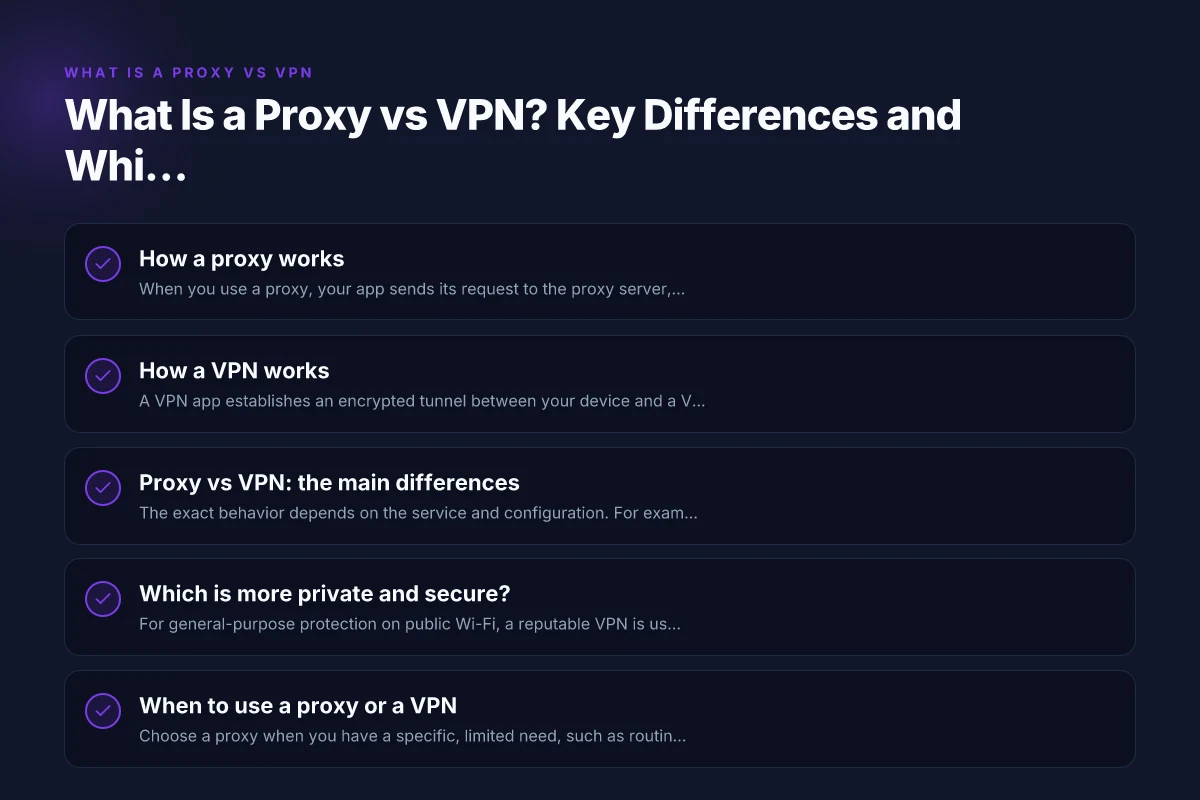
How a proxy works
When you use a proxy, your app sends its request to the proxy server, which then contacts the website or service on your behalf. The destination sees the proxy server’s IP address rather than your usual public IP address.
Proxies come in different forms. An HTTP or HTTPS proxy is designed for web traffic, while a SOCKS proxy can handle a wider range of traffic. A proxy may be set up in a browser, a specific app, or on a device, depending on the type and configuration.
A proxy can be useful when you want to route a particular service through another server. However, many proxies do not encrypt the connection between your device and the proxy. HTTPS can still encrypt data between your browser and a website, but that does not mean every part of your connection is protected by the proxy itself.
How a VPN works
A VPN app establishes an encrypted tunnel between your device and a VPN server. Traffic covered by the VPN travels through that tunnel before reaching its destination. Websites and online services typically see the VPN server’s IP address, not your home or mobile connection’s public IP address. Edge Extensions VPN: How to Choose and Use One Safely
Depending on its settings, a VPN can route traffic from the whole device or only from selected apps. The encryption helps protect traffic from being read by people on the same local network, such as users connected to public Wi-Fi.
A VPN does not make you invisible. The VPN provider may be able to see some connection information, and websites can still identify users through account logins, cookies, browser fingerprinting, or other signals.
Which option fits your need?
| Need | Proxy | VPN |
|---|---|---|
| Change IP for one app | Often suitable | Suitable if app routing is supported |
| Route all device traffic | Usually not | Often supported |
| Encrypt traffic on public Wi-Fi | Usually not | Yes, to the VPN server |
| Browse with less provider visibility | Depends on proxy provider | Depends on VPN provider |
| Quick, app-specific setup | Often suitable | May require broader setup |
| Protect traffic from local network observers | Limited | Better for routed traffic |
| Avoid trusting a service provider | No | No |
Compiled November 2026; check the provider's site for current details. Urban VPN Microsoft Edge: Setup, Features, and Privacy Considerations
Proxy vs VPN: the main differences
| Feature | Proxy | VPN |
|---|---|---|
| What it routes | Often one app or type of traffic | Often device-wide or app-selected traffic |
| Encryption | Not always included; varies by proxy and setup | Usually encrypts traffic between your device and the VPN server |
| IP address shown to websites | Usually the proxy server’s IP | Usually the VPN server’s IP |
| Setup | Often configured in an app or browser | Usually configured through an app or system settings |
| Best suited to | Routing specific traffic through another server | Broader connection privacy and protection on public networks |
| Main trust consideration | The proxy operator may handle your requests | The VPN provider becomes a party you need to trust |
The exact behavior depends on the service and configuration. For example, an incorrectly configured VPN may allow some traffic to bypass the tunnel, while a proxy may support encryption for certain connections. Check the provider’s documentation rather than relying on the product label alone.
Which is more private and secure?
For general-purpose protection on public Wi-Fi, a reputable VPN is usually the more suitable choice because it encrypts the connection between your device and the VPN server. This can make it harder for others on the same network to inspect that traffic.
A proxy may hide your original IP address from the destination, but IP masking is not the same as encryption. If the connection is not encrypted, information could be exposed between your device and the proxy. HTTPS protects the connection to a supported website, but it does not encrypt unrelated traffic or prevent every kind of monitoring.
Both tools shift some trust from your internet provider or local network to another service. Before using either, consider: Cisco VPN Client: What It Is, How to Choose, and What to Use Today
- Who operates the service and what their privacy policy says.
- Whether it records activity or connection data.
- Whether encryption is included and how it is implemented.
- Whether the service has clear security practices and reliable support.
- Whether your use complies with the rules of the website, network, or workplace involved.
Free services are not automatically unsafe, but a free price does not tell you how a provider is funded or what data it collects. Review the terms carefully.
When to use a proxy or a VPN
Choose a proxy when you have a specific, limited need, such as routing one browser or app through a different server. It can be convenient if you do not need device-wide coverage or if the service you use requires a particular proxy configuration.
Choose a VPN when you want to protect more of your device’s internet traffic with an encrypted connection, especially when using networks you do not control. A VPN can also route traffic through a server in another location, though streaming platforms and other services may restrict or block this use.
Neither tool is a substitute for good security habits. Keep software updated, use strong unique passwords, enable multifactor authentication, and avoid entering sensitive information on suspicious websites. A VPN or proxy also does not guarantee access to content, bypass every network restriction, or prevent tracking by sites where you are signed in. F5 VPN Client: What It Is, How to Get It, and How to Connect
Choosing a proxy or VPN
| Decision factor | Choose a proxy when… | Choose a VPN when… |
|---|---|---|
| Scope | You only need selected traffic routed | You want broader device coverage |
| Main goal | You need an IP change for an app | You want encryption as well as IP masking |
| Network | Encryption is not the priority | You use public or untrusted Wi-Fi |
| Privacy expectations | You accept provider-dependent privacy | You trust the VPN provider |
| Setup preference | You prefer app-specific configuration | You prefer a device-level connection |
| Limitations | You can work without built-in encryption | You accept provider trust and possible speed impact |
Compiled November 2026; check the provider's site for current details.
Recommendation: which should you choose?
If your main goal is broader protection for your device’s connection, choose a reputable VPN with transparent privacy and security practices. If you only need to route traffic from one particular app or browser, a proxy may be enough, provided you understand whether it encrypts that connection.
In short, a proxy is a targeted routing tool. A VPN is generally a broader encrypted connection. Select the option that matches your needs, and remember that the provider’s trustworthiness matters as much as the technology. Cisco Secure Client VPN: What It Is and How to Use It