Where Is My VPN? How to Find It and Check That It’s Working
Find your VPN app, connection settings, and current VPN status on common devices, then troubleshoot if it is missing.
If you’re asking “where is my VPN,” look first for a VPN app on your device or a VPN setting in its network settings. Open the app or settings page to see whether you’re connected. The exact location depends on your device and how the VPN was installed: it may be a personal app, a work or school profile, or a connection configured manually.
Common places to find VPN settings or apps by device
| Device | Where to look | What to look for | If it’s not there |
|---|---|---|---|
| iPhone or iPad | Settings; Home Screen; App Library | VPN status or a VPN app | Search Settings and App Library |
| Android phone or tablet | Settings; app drawer | VPN settings or a VPN app | Search Settings and installed apps |
| Windows PC | Settings; system tray; Start menu | VPN settings, connection status, or app | Search installed apps and Settings |
| Mac | System Settings; menu bar; Applications | VPN settings or a VPN app | Check Applications and network settings |
| Chromebook | Settings; launcher | VPN settings or a VPN app | Search Settings and installed apps |
| Router | Router’s app or admin page | VPN client settings or status | Check the router’s documentation |
| Work or school device | Managed settings; organization’s app | Organization-provided VPN | Ask your IT administrator |
Compiled November 2026; check the provider's site for current details.
| VPN | Obfuscation | From / month | Plan | Free plan | Refund | Alipay | UnionPay | Crypto | Website opens in China | Trustpilot | |
|---|---|---|---|---|---|---|---|---|---|---|---|
 ZoogVPN | Turn on manually Shadow | $2.49/mo | 27 months: $59.99 | Yes | 7 days | ✓ | ✓ | ✓ | ✓ | Official site blocked; our special link opens (4.4 s) | 4.2/5 (195 reviews) |
 NordVPN | Turn on manually Obfuscated Servers / NordWhisper | $3.49/mo | 27 months: $94.23 | No | 30 days | ? | ✗ | ✓ | ✓ | ✗ Blocked | 4.2/5 (51,628 reviews) |
 ExpressVPN | ✓ On by default all servers | $3.00/mo | 28 months: $84 | No | 30 days | ✗ | ✗ | ✓ | ✗ | ✗ Blocked | 4.4/5 (29,706 reviews) |
 Surfshark | ✓ On by default Camouflage, with OpenVPN | See site | See site | No | 30 days | ✗ | ✗ | ✗ | ✓ | ✗ Blocked | 4.3/5 (31,823 reviews) |
 Proton VPN | Turn on manually Stealth, free plan too | $2.99/mo | 12 months: $35.88 | Yes | 30 days | ✗ | ✗ | ✗ | ✓ | ✗ Blocked | 2.1/5 (1,040 reviews) |
 Astrill VPN | Turn on manually StealthVPN / OpenWeb | $12.50/mo | 24 months: $300 | No | See site | ✗ | ✗ | ✗ | ✓ | ✗ Blocked | 1.3/5 (110 reviews) |
 Private Internet Access | Turn on manually Shadowsocks, OpenVPN only | $2.03/mo | 40 months: $81.2 | No | 30 days | ✗ | ✗ | ✗ | ✗ | ✗ Blocked | 4.2/5 (11,033 reviews) |
 CyberGhost | Turn on manually selected servers | $2.19/mo | 28 months: $61.32 | No | 45 days | ✗ | ✗ | ✗ | ✓ | ✗ Blocked | 4.0/5 (24,178 reviews) |
 PureVPN | Turn on manually switch to OpenVPN | $1.69/mo | 60 months: $101.55 | No | 31 days | ? | ? | ✗ | ✓ | ✗ Blocked | 4.4/5 (17,994 reviews) |
 AdGuard VPN | ✓ On by default TrustTunnel | $2.99/mo | 24 months: $71.76 | Yes | 30 days | ✓ | ✗ | ✓ | ✓ | Official site blocked; our special link opens (3.7 s) | 4.3/5 (290 reviews) |
 Mullvad | Turn on manually QUIC / Shadowsocks / LWO | $5.61/mo | €5/mo | No | 14 days | ✗ | ✗ | ✗ | ✓ | ✗ Blocked | 3.2/5 (192 reviews) |
 Windscribe | Turn on manually Stealth / WStunnel | $5.75/mo | 12 months: $69 | Yes | See site | ✗ | ✗ | ✗ | ✓ | ✗ Blocked | 4.7/5 (13,355 reviews) |
 StrongVPN | Turn on manually Scramble, OpenVPN TCP | See site | See site | No | 30 days | ✓ | ✗ | ✗ | ✗ | ✗ Blocked | 4.4/5 (2,695 reviews) |
 LightXtreme 闪连 | Not listed | $7.08/mo | 12 months: $84.99 | Yes | 30 days | ✓ | ✓ | ✓ | ✓ | ✓ Yes (3.5 s) | No page |
Prices checked 2026-11-10 on each vendor's pricing page (cheapest long plan, USD). Check the vendor's checkout for the final price.
Obfuscation checked 2026-11-14 on each vendor's site and help center: "on by default" = nothing to set; "turn on manually" = switch protocol or mode in settings; "not listed" = the vendor describes no obfuscation.
Payment methods checked 2026-11-10 on each vendor's payment pages: all 14 take cards and PayPal; ✗ = not listed, ? = the vendor's own pages disagree.
China access: whether the official website opens from mainland China networks (tests the website only, not the VPN connection). Last checked 2026-11-18 01:02 Beijing time.
Trustpilot score and review count checked 2026-11-10.
Find your VPN on your device
On iPhone or iPad
Look for the VPN app on your Home Screen or in the App Library. You can also swipe down on the Home Screen and search for “VPN” or the app’s name.
To find built-in connection settings, go to Settings > General > VPN & Device Management > VPN. On some versions of iOS or iPadOS, you may see a VPN entry directly in Settings when a configuration is installed.
A VPN status indicator may appear near the top of the screen while the connection is active, depending on your device and software version. Open the VPN app or settings to verify the connection rather than relying only on the icon.
On Android
Search your app drawer for the VPN provider’s app, or use your phone’s search feature. To check system settings, open Settings and search for “VPN.” The option is commonly under Network & internet > VPN, though menu names vary by Android version and manufacturer. Urban VPN: Features, Apps, and What to Consider
If your phone is managed by an employer or school, the VPN may be installed through a work profile or management app. Check for a separate work section in the app drawer, or contact your organization’s IT team before changing or removing anything.
On Windows
Search the Start menu for your VPN provider’s app. To find connections configured in Windows, open Settings > Network & internet > VPN. You can view available VPN connections and their status there.
A VPN may also connect through a company security app, so it might not appear as a familiar standalone VPN connection. If the device belongs to your employer or school, check their setup instructions.
On Mac
Look in the Applications folder, Launchpad, or Spotlight for your VPN provider’s app. For manually configured connections, open System Settings > VPN. Depending on your macOS version and setup, VPN options may also be associated with network settings or a device management profile. iPhone Clash: What It Means and How to Fix Common Conflicts
If you do not see an app or connection, that does not necessarily mean your Mac has never used a VPN. A connection may have been removed, may require an organization’s management profile, or may be available only through a particular app.
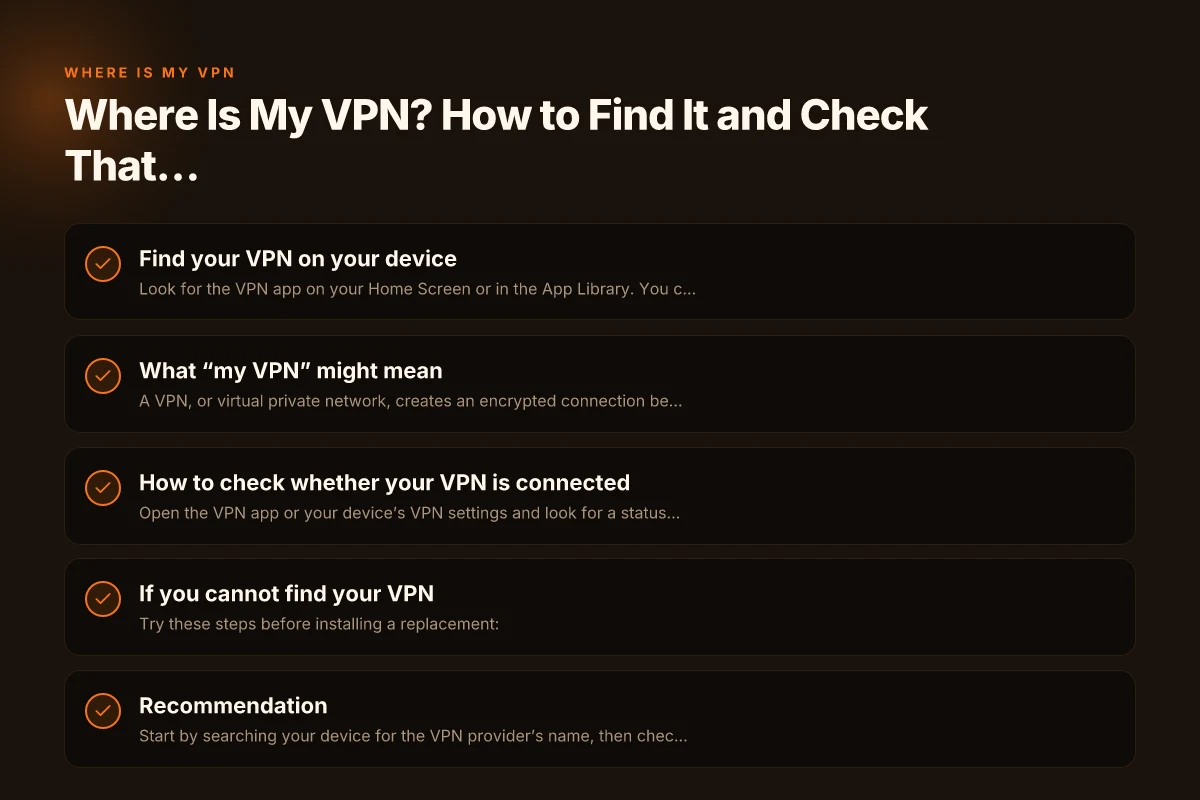
What “my VPN” might mean
A VPN, or virtual private network, creates an encrypted connection between your device and a VPN service or organization. People may use the phrase “my VPN” to refer to different things:
- A VPN app: Software from a provider that lets you choose a server and connect.
- A built-in VPN connection: A profile entered in your device’s network settings.
- A work or school VPN: A connection provided and managed by an organization.
- A browser VPN or proxy: A feature that may protect only activity inside that browser, not all device traffic.
| Type | Where to look | What it usually covers |
|---|---|---|
| Provider app | Home Screen, app drawer, Applications, or Start menu | Often most device internet traffic when connected |
| Built-in connection | Device network or VPN settings | Traffic routed through the configured connection |
| Work or school VPN | Organization app, work profile, or managed settings | Access to workplace or school resources |
| Browser feature | Browser settings or extension list | Usually browser traffic only |
A VPN is not always active just because its app is installed. Likewise, some VPNs connect automatically in the background, so you may not need to open the app each time.
What “my VPN” might mean CJ VPN: What the Search Term Means and How to Choose a VPN
| What you mean | Where to check | What confirms it | Who may manage it |
|---|---|---|---|
| VPN app | App list or Home Screen | The app is installed | You or your organization |
| VPN connection | Device network settings | VPN shows as connected | You or an administrator |
| VPN service | Account or provider app | You can sign in to the service | VPN provider |
| Work or school VPN | Organization’s instructions | The required profile or app appears | IT administrator |
| Router VPN | Router settings | VPN client is configured | Router owner or administrator |
| Browser proxy or extension | Browser settings or extensions | Proxy or extension is enabled | You or the browser administrator |
Compiled November 2026; check the provider's site for current details.
How to check whether your VPN is connected
Open the VPN app or your device’s VPN settings and look for a status such as Connected, On, or Active. If it says Disconnected, Paused, or Connecting, your device may not currently be using the VPN.
You can also look for a VPN icon or status indicator, but its appearance and availability vary by device. For an additional check, visit a reputable IP-checking website before and after connecting. If your public IP address or reported location changes, that can indicate your internet traffic is using a different exit point. It is not a complete security test, and some VPNs route only selected traffic.
Keep in mind that a changed IP address does not prove every app or connection is protected. Split tunneling, browser-only VPN features, or connection problems can affect what goes through the VPN. Review your provider’s settings if you need to know exactly what is covered. VPN Extension for Edge Browser: How to Choose and Use One
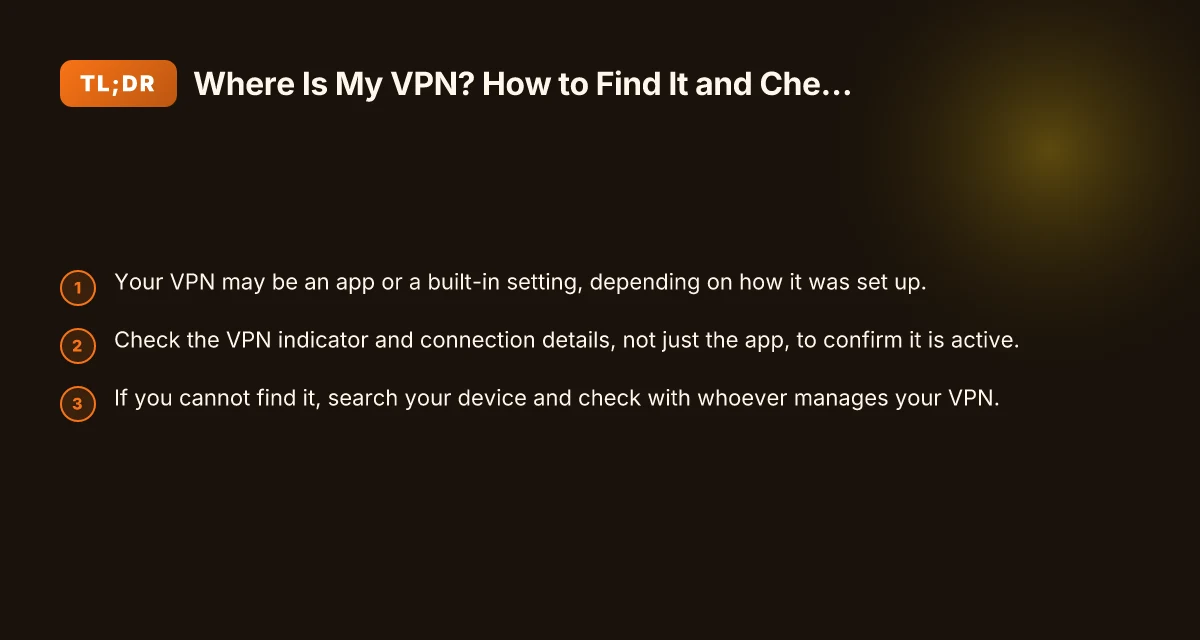
If you cannot find your VPN
Try these steps before installing a replacement:
- Search by provider name. Look for the name of the company, app, or organization that supplied your VPN.
- Check installed apps. Review your device’s app list, Applications folder, or Start menu for VPN software.
- Search Settings. Use the device settings search box and enter “VPN.”
- Check management profiles. Work and school VPNs may be installed through device management rather than a personal app.
- Ask the provider or administrator. They can confirm whether you should have an app, profile, or login and provide the correct setup steps.
If you find an app but it will not connect, check your internet connection, sign-in status, and subscription or organization access. Restarting the app or device may help. Avoid deleting a work or school profile unless your IT team says it is safe, since it could remove access to other managed services.
Only download a VPN app from the official app store or the provider’s verified website. An unfamiliar VPN app is not automatically trustworthy, and installing multiple VPNs can create connection conflicts.
Ways to check whether your VPN is working Urban VPN Extension for Edge: How to Install and Use It
| Check | What to do | Working sign | If the result is unclear |
|---|---|---|---|
| Connection status | Open the VPN app or device settings | Connected status is shown | Reconnect or check settings |
| VPN app indicator | Check the app’s connection screen | App reports an active connection | Review the app’s help |
| Public IP address | Check an IP lookup before and after connecting | Address changes when connected | Try another lookup service |
| Location | Check the location shown by an IP lookup | It reflects the VPN server location | Confirm the selected server |
| Network access | Open a website or app | It loads while VPN is on | Try another network or server |
| Disconnect test | Turn off the VPN and compare results | Status or IP changes after disconnecting | Check whether the VPN reconnects automatically |
| Organization access | Open a work or school resource | The required resource is reachable | Contact your IT administrator |
Compiled November 2026; check the provider's site for current details.
Recommendation
Start by searching your device for the VPN provider’s name, then check its VPN or network settings. Confirm the connection inside the app or settings page, and ask your employer, school, or VPN provider if you are unsure which setup you are supposed to use.